
For consultants and coaches
The plan was good. The change still slipped.
You did the work. The leadership sessions went well, the plan was clear, and the first month looked promising. Then, a few months on, you hear it slipped back.
Most consultants and coaches do strong work on the system: leadership, teams, policy, workflow and culture. The part that gets missed is the people carrying the plan. How does their nervous system respond to pressure and to change? And what do they believe about their work, underneath what they say out loud? A plan that skips those two questions is built for people who are not actually there.
Start with our free four-page PDF on the two layers most change plans skip.


What we look at
Belief and bandwidth, underneath the plan.
Our work draws on neuroscience, cognitive science and years of working with people under heavy load. In plain terms, we look at how people’s nervous systems respond to their work, and at the beliefs underneath how they do it.
- A good plan fades because people never had room to take it in. People under sustained load can have less bandwidth for anything new. Attention can narrow to getting through the day.
- A new policy gets bent back into the old shape because the belief underneath it never moved. “If we don’t push, people slack.”
- A generous change can land as a risk because of how, and how fast, it arrived.
None of this means people are broken. It means the plan did not account for the people carrying it. When it does, people tend to think more clearly and bring their best judgment back to the work.

Two cases
How the same lens fits very different situations.
A community nonprofit
About 100 people across several sites already had a wellness program that was generous on paper and uneven in use. We listened first, with an anonymous survey and conversations across roles. Then we shaped the changes with staff from every department, and rolled them out slowly. The program now reaches far more of its staff, in ways that fit their roles, and the organization’s own key measures moved in the right direction.
An officer on the edge of leaving (a teaching case)
Details are changed, and the work did not go ahead, so this shows how we read a situation, not a result. An officer planning to leave the job described their supervisors as abusive. Outside support was not landing, and they could not stay engaged at home either. What we saw was a pattern we look for, not a diagnosis: heavy, sustained strain that is easy to miss because it is not a recognized condition. We would have started with calm, because under that much strain, taking in anything new is hard. Then information, then habits and the pull to avoid change. We heard one side. Even so, a retention effort there would reach people whose load no one could see.
How we work with consultants
You keep your clients and your frameworks. We add the human layer underneath.
You stay the client of record
Work with us behind the scenes and we never meet your client. Or bring us inside your engagement, and your client never hears from us without you.

Consulting to you
We look at a client situation with you, behind the scenes. You carry it into the room.
Working sessions
Belief and bandwidth, taught through real cases shared without names, so you can spot both before a plan is built.
Live engagements
Alongside you on one client, close to the leaders carrying the change.
A pulse check
A short link for your client’s people and a brief report on how the change is landing.
Each one is scoped to the group and the situation. Pegasus Realm is led by Adam Grimm: M.A. Clinical Psychology, completing doctoral studies in clinical psychology, and 21 years in the US Air Force, 13 of them in bomb disposal.
Why this tends to be the missing piece
Uncertainty about what change will bring can register as a threat.
That is part of why change is hard for one person and harder across a group. So the order matters, and the work does not end with one good session.
- 1
Steady
Enough calm that people can take something new in.
- 2
Teach
The new information, once it can land.
- 3
Consult
Fit it to this organization and these people.
- 4
Support
Through the change, with repeated practice, until it holds.
Most consultants do strong work on steps two and three. If your follow-ups keep sounding like “great information, limited change,” ask one question:
Did the work walk the nervous system all the way through?
Free PDF · 4 pages
Take the full version with you.
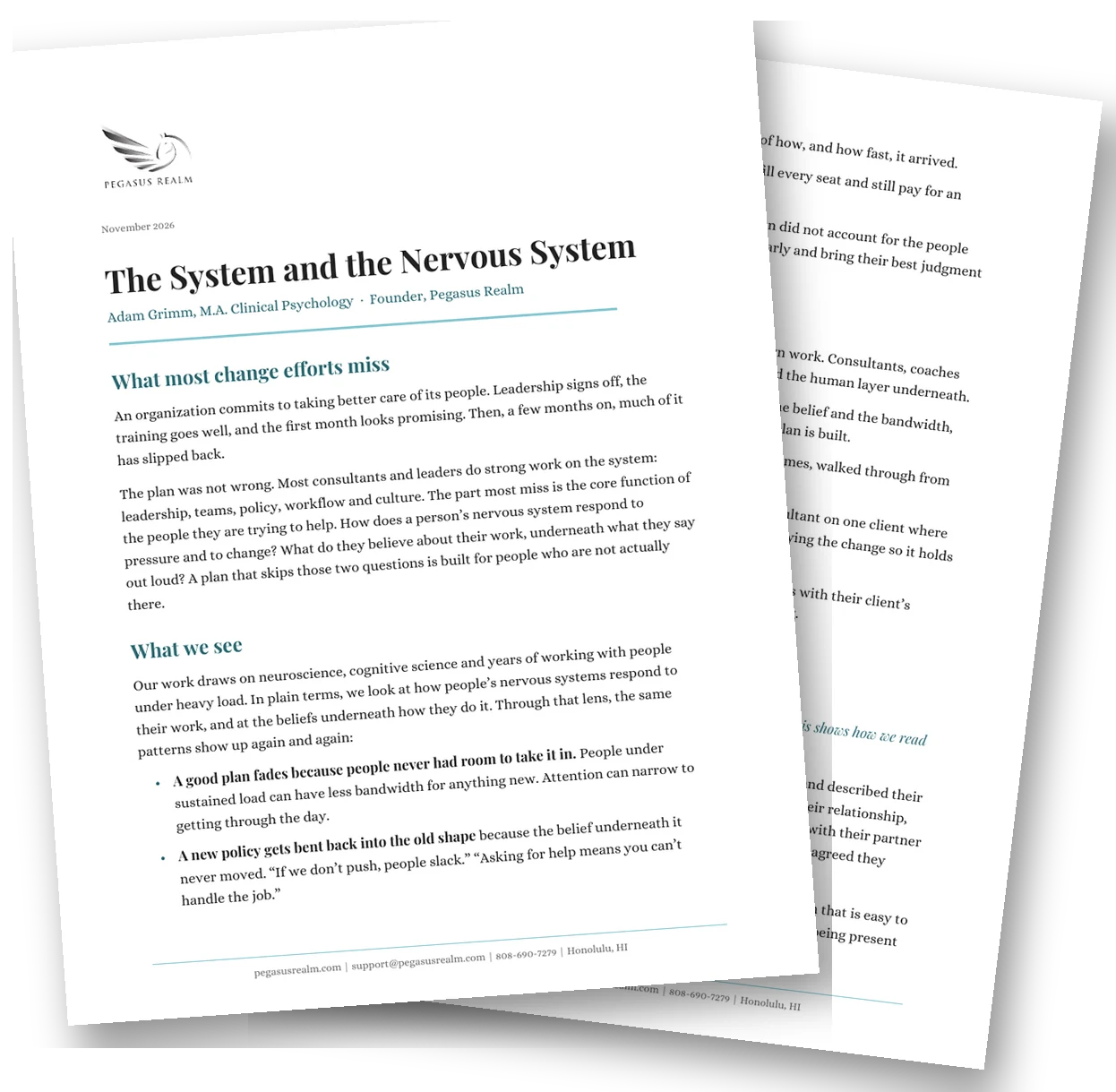
“The System and the Nervous System” puts this page into a short PDF you can read later or pass to a colleague.
- The two layers most change plans skip
- Two cases, from first signs to what changed
- How we work alongside consultants
Leave your email and the PDF opens on the next page. You’ll also get occasional notes from Pegasus Realm. Unsubscribe any time.
Sources: Arnsten, A. F. T. (2009). Nature Reviews Neuroscience, 10, 410–422. Cepeda, N. J. et al. (2006). Psychological Bulletin, 132, 354–380. Grupe, D. W. & Nitschke, J. B. (2013). Nature Reviews Neuroscience, 14, 488–501. Murre, J. M. J. & Dros, J. (2015). PLoS ONE, 10, e0120644. Peters, A., McEwen, B. S. & Friston, K. (2017). Progress in Neurobiology, 156, 164–188.